

Beyond the Title: Isabelle Bazsó on Purpose, Leadership and Building BCCC
Meet Isabelle Bazsó, BCCC’s Director of Operations, and discover the experience, purpose, and people behind her approach to clinical research operations.
With nearly 30 years of experience in clinical research and operations across CRO, biotech, and pharmaceutical environments, Isabelle Bazsó brings a broad, global perspective to the field. Today, she is leading the operational build of BCCC, a full-service non-profit CRO, overseeing a team of nearly 50 professionals across a wide range of functions.
Throughout her career, Isabelle has worked across hands-on people leadership, clinical research operations, GCP auditing, and collaboration with senior investigators, international sponsors, and executive stakeholders. Her experience has given her both a strategic perspective and a deep understanding of the realities of clinical research.
But behind the operational expertise is a clear philosophy: clinical research is ultimately about people — the participants who place their trust in research, the teams who deliver it, and the relationships that make good research possible.
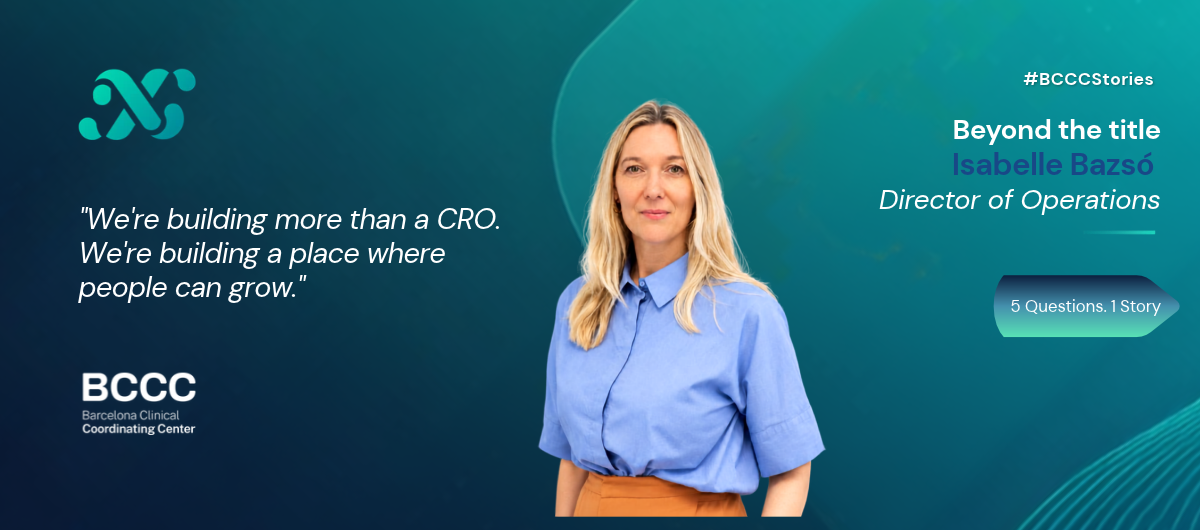
In this edition of #BCCCStories, Isabelle reflects on the unexpected beginning of her career, the principles that continue to guide her, the human side of clinical research operations, and what motivates her to help build BCCC.
From an unexpected beginning to a purpose-driven career
There have been many chapters in your professional journey. Looking back, what drew you to clinical research, and ultimately to BCCC?
Honestly, I never planned to end up in clinical research.
After completing my studies in Hospital Management and Public Health, I joined a small Belgian CRO almost by chance. I did not really know the field at the time, but something about it connected with my background and my curiosity.
What kept me was my very first assignment. I was assigned to one of the world’s leading pharmaceutical companies to work on an HIV clinical development programme, right in the middle of the global AIDS epidemic.
Seeing how molecules were working and how treatments were developing in real time for people who were dying left a mark on me that never went away. From then on, I understood what this work was really about.
That experience gave clinical research a meaning that went far beyond processes, projects or deliverables. It showed me the potential of research to change people’s lives.
BCCC felt like a natural destination because it carries that same spirit — research with a real purpose, not just a commercial one.
Putting the participant first
At BCCC, success is not only measured in milestones and deliverables, but in the impact research can have on patients’ lives. How does that purpose shape the way you lead your team?
When I was working as a GCP Auditor, my personal motto was always: think about the participant first.
GCP guidelines and ICH regulations are not just bureaucracy. They are safeguards that ensure every person in a clinical trial is treated with integrity, with ethics, and with the best possible care.
That principle stayed with me.
What I found particularly moving, many times, was that in clinical research you can sometimes see the impact of a molecule or medical device on patients before the world even knows the results. You witness something quietly extraordinary.
That creates a tremendous sense of responsibility.
Our role is to protect that process and to make sure that it is done right. That responsibility is something I try to bring into the way I lead my team every day.
For me, operational excellence is therefore not an end in itself. It is part of our responsibility towards the people who participate in clinical research and place their trust in us.
The human side of clinical research operations
Operations are often seen as processes and timelines. What do you think people overlook about the human side of running clinical trials?
People think it is about processes and timelines — and yes, those are essential.
But what I have discovered over the years is that the best work happens between people who trust each other.
I have shared long projects, difficult moments, and real pressure with colleagues who are now close friends in my life. That does not happen by accident.
The human side is just as important at the investigational site level. We do not simply visit sites to check boxes — we invest in them.
We transfer our knowledge, support teams in reaching an elevated level of Good Clinical Practice, and build real working relationships.
That relationship-building takes time, commitment, and trust. But it makes a difference.
Because in the end, good relationships lead to good data, and good data leads to better treatment for patients.
For me, that is one of the most important things to remember when we talk about clinical research operations. Behind every process, every timeline and every dataset, there are people working together towards a common goal.
What sponsors discover when they work with BCCC
After working with sponsors and partners for years, is there something they are often surprised to discover about BCCC once the collaboration begins?
I think what surprises our clients is the depth of our commitment.
They come expecting professionalism — and they find it. But they also find something more: a team that is genuinely invested in their plans and strategies, that constantly looks at how to improve, and that develops its people and expertise with real intention.
We do not just deliver and move on.
We reflect. We grow. We take pride in doing better each time.
I think sponsors sometimes do not expect that level of dedication from a non-profit CRO. And when they discover it, it changes the relationship completely.
For me, that commitment is an important part of what we are building at BCCC. Being a non-profit CRO does not mean having less ambition or lower standards. It means being able to bring a different sense of purpose to the work and to the relationships we build around it.
Staying curious after nearly three decades
What keeps you motivated, after all these years, in clinical research?
The feeling that there is still so much to do.
When I think about orphan diseases, about the specific health needs of women that for so long were simply not studied, and about malaria and the populations that still carry the heaviest burden, there is no shortage of reasons to keep going.
At the same time, the field itself continues to expand.
Advanced therapies, medical devices and engineering innovations are opening possibilities that were simply not imaginable when I started. And now we are seeing what AI is beginning to bring to research — in precision, in speed, and in the way we analyse and understand data.
Honestly, I find myself as curious and excited as I was on my very first day.
But I have to say that what motivates me enormously right now is BCCC itself.
We are a young organisation, a real start-up, and that gives me something I genuinely love: the opportunity to mentor my team and to transfer not just knowledge, but a spirit.
I care deeply about building a workplace that is human-centred, flexible, kind, respectful and inclusive.
Clinical research is a demanding environment. Precisely because of that, people deserve to work somewhere they feel valued and supported.
That is one of the reasons I said yes to this adventure.
And I am truly proud of what we are building. We have wonderful people and real talent in this team.
Building more than a CRO
Isabelle’s journey reflects the evolution of clinical research itself: from the urgency of developing treatments for people facing devastating diseases to an increasingly complex landscape of advanced therapies, medical devices, new technologies, and AI-driven innovation.
But her perspective also highlights something that can be easy to overlook when discussing clinical research operations: the work is ultimately human.
It is about participants and patients. It is about investigators and site teams. It is about sponsors and partners. And it is about the people who work every day to make clinical research possible.
For Isabelle, building BCCC means bringing these elements together — operational excellence, scientific purpose, strong relationships and a workplace where people can develop and thrive.
Because BCCC is not only about building a CRO.
It is about building a place where people can grow.

